Intro Columbus, the tallest mass timber student housing in the U.S., tops out ahead of schedule, enhancing the state's sustainability focus and housing options.
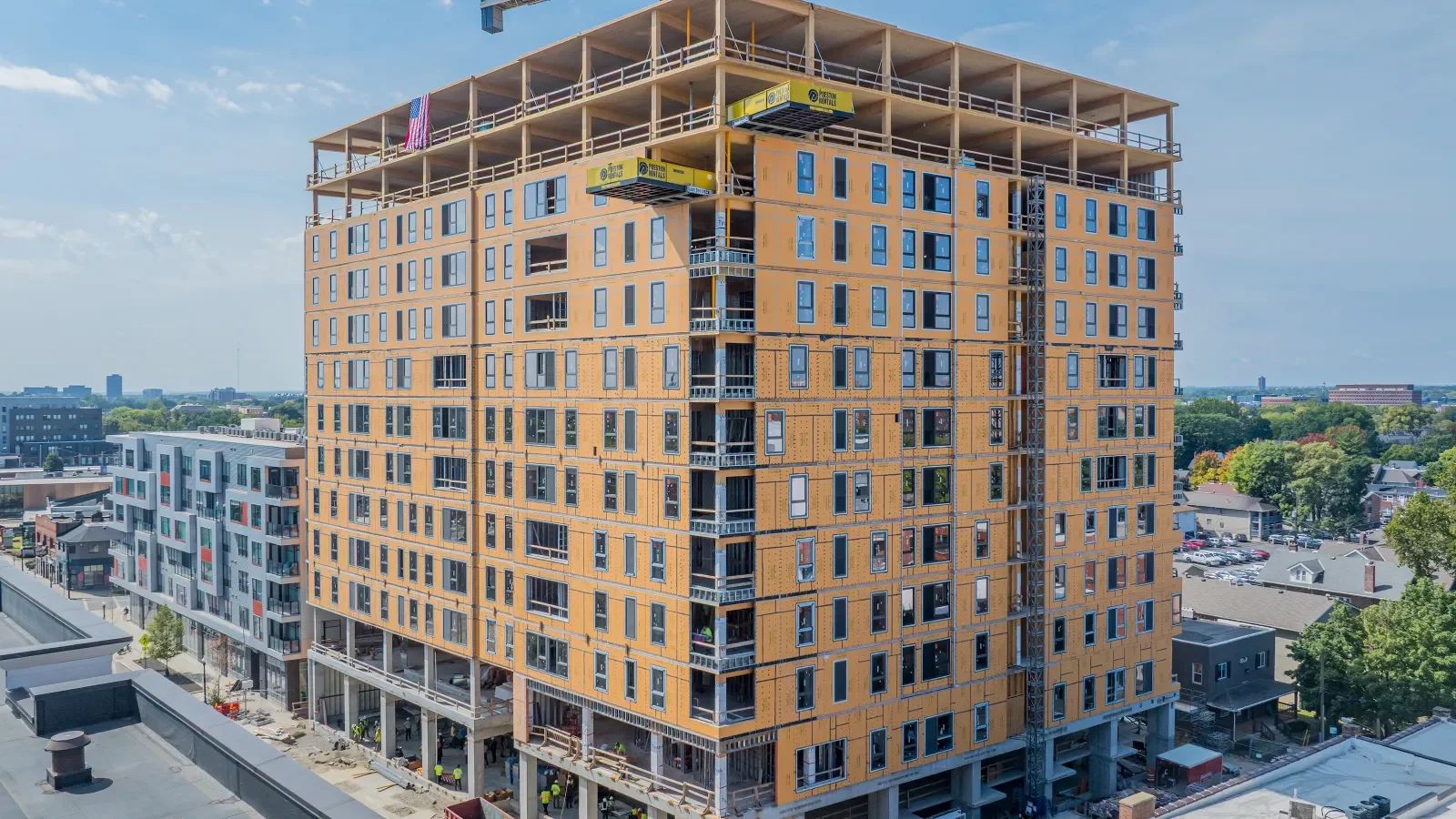
A significant milestone has been achieved with the topping out of Intro Columbus, a remarkable 13-story mass timber student housing building near Ohio State University. The development, which measures 158 feet high and encompasses 242,000 square feet, stands as the tallest of its kind in the United States and is set to feature 186 residential units. This project not only marks an architectural achievement but also positions itself within a narrative focused on sustainable and efficient construction methods.
Project Details and Construction Timeline
The groundbreaking for Intro Columbus took place on a September morning not too long ago. While the developers aimed for a standard timeline, they completed the work nearly 10 weeks ahead of schedule. This boost in productivity can largely be attributed to the innovative construction techniques employed. The use of glulam columns and beams, coupled with cross-laminated timber (CLT) panels, dramatically altered how efficiently the structure could be erected. A typical construction project at this scale might expect to take several months just to reach the framing stage, but here, the team installed up to 44 CLT panels daily, assembling two-and-a-half floors every couple of weeks.
Shane Warner, superintendent from Elford Construction, expressed satisfaction with the project’s progress, noting that “the erection went about as smoothly as you could ask for.” Such praise in construction often points to meticulous planning and execution—a crucial fundamental often overlooked in articles focused on flashy advancements. The general contractor, Elford Construction, partnered with a consortium that included Forefront Structural Engineers and mass timber manufacturer SmartLam North America, based in Dothan, Alabama. The collaboration showcases how various specialists can converge to harness mass timber's full potential.
Sustainability and Future Applications
The materials used not only emphasize speed but also sustainability, with domestic timber sourced from Alabama, an aspect that resonates strongly in today’s environmental climate. This strategic choice in material selection is projected to sequester around 1,128 metric tons of carbon dioxide, a notable achievement compared to traditional steel and concrete designs that often carry higher carbon footprints. According to DLR Group, this project serves as a case study for how architecture can deliberately address climate change through thoughtful material choices.
What this means for you, if you're working in this space, is that the implications of Intro Columbus extend beyond simple student housing. Traditional materials are often burdened with volatile pricing and extended lead times, which can create challenges in project planning. As steel prices rise, timber's versatility is gaining heightened recognition, making it an attractive alternative even for ostensibly unrelated constructions, such as data centers. The shift toward mass timber in diverse sectors could signify a broader industry trend, and developers should start taking a closer look at these potential shifts.
Moreover, the architectural and engineering community is taking note of how this type of construction can serve to redefine standard practices. Mass timber structures have the potential not just for homes or apartments but also for commercial buildings, schools, and even public facilities. This evolution invites a paradigm shift: can we really afford to ignore sustainable practices and materials as a central component of future projects?
Implications and Future Outlook
The Intro Columbus project is targeting completion in 2027, a timeline that may seem ambitious but achievable given its current trajectory. As it stands, the building sets benchmarks not just for sustainable architecture and student accommodations but for future developments across the board. The implications go further—cities grappling with housing shortages may see buildings like this as models to emulate. With rising populations in urban centers, the demand for environmentally conscious yet efficient housing options will only grow.
But challenges remain. While mass timber constructions like Intro Columbus are trailblazers of sorts, there’s ongoing skepticism in the industry regarding fire safety, regulatory hurdles, and the costs associated with mass timber frameworks. Some critics argue that the shift might not be rapid enough to meet increasing housing demands effectively. After all, while wood has its merits, it isn’t a silver bullet for all construction needs. (And this is the part most people overlook.)
Investors, developers, and city planners will do well to watch how the success of Intro Columbus influences subsequent projects. If it's successful, similar constructions can ignite a more widespread embrace of mass timber systems across various sectors. This isn't just about one building; it's about creating a dialogue that could reshape our approach to sustainable architecture. In an era where environmental accountability is becoming increasingly important, don’t underestimate the power of what’s happening in Columbus. The project could very well represent a tipping point for mass timber as the industry grapples with the dual mandate of affordability and sustainability.
Discussion
Sign in to join the discussion.